
Can you flip a Tesla for a profit? Can you resell a Tesla right after you take delivery and make some money? How does sales tax factor in? What about other EVs?
These are questions we still get sometimes from buyers, sellers, and people browsing Find My Electric.
And make no mistake about it—this is still a discussed topic. It just is not the same topic it was in 2021 and 2022. Back then, production delays, reservation backlogs, and wild used EV pricing made some new EV flips look easy. In 2026, the market is much more normal, Tesla pricing changes quickly, many EVs are easier to get, and the margin for casual flipping is a lot thinner.
So where does that leave someone who is ready to take delivery of an EV reservation they placed a long time ago? Or someone who has owned a new EV for a few months and wants to sell it?
We’re going to dive into all of that right here. But first:
Quick disclaimer: We are not Tesla, we are not an automaker or dealer, and this article is general information only—not legal, tax, financial, insurance, DMV, title, contract, or resale advice. Rules around vehicle resale, title transfer, liens, registration, taxes, incentives, exports, automaker order agreements, dealer paperwork, and marketplace policies can change. Do not use this article to avoid or work around any Tesla, automaker, dealer, lender, DMV, tax, title, or contractual requirement. Before buying an EV with resale in mind or selling soon after delivery, review your actual purchase agreement, loan or lease terms, title documents, state DMV rules, tax rules, insurance policy, and any marketplace or payment service terms that apply. For private party transactions, we strongly recommend using a secure vehicle transaction service such as KeySavvy where available to help with payment handling, title verification, lien payoff, paperwork, and related transaction steps. KeySavvy is not a way to sell a car you do not own, transfer a reservation, avoid taxes, bypass automaker rules, or skip required DMV/title steps.
With that out of the way, let’s dive in.
Are Teslas and EVs Actually Selling for Over MSRP?
Short answer: sometimes.
Long answer: it depends on a lot of different factors, and it is a lot less common than it was during the peak shortage years.
If you’re looking at flipping a Tesla or EV, one of the first questions is whether you can sell it for more than you paid. That depends on the vehicle, your purchase price, taxes and fees, title timing, current new inventory, available incentives, the exact configuration, mileage, condition, and how quickly the manufacturer can deliver a similar vehicle to a new buyer.
The old EV flipping market was heavily driven by scarcity. When new EV supply was tight, early reservation holders could sometimes take delivery and resell into a market full of impatient buyers. That happened with early Rivian R1T deliveries, some early Ford F-150 Lightning deliveries, some hard-to-get Tesla configurations, and later with certain early Cybertruck listings.
But scarcity is not permanent. Once more vehicles hit the road, wait times shrink, new inventory appears, and buyers have more options, resale premiums usually fade fast. That is the part many casual flippers underestimate.
In a more normal 2026 market, asking over MSRP is still possible in isolated situations, but it is no longer something a seller should assume. A rare configuration, an early limited-production vehicle, a hard-to-find trim, or a very specific local market can still create a premium. A common Tesla configuration that can be ordered new with a short delivery timeline usually does not give a seller much leverage.
In cases like this, you have to ask yourself: is it really worth taking delivery of an EV, carrying insurance, paying sales tax and fees, waiting for title paperwork, finding a buyer, dealing with payment risk, handling payoff/title transfer, and possibly creating tax issues just to maybe make a few grand?
Often, the answer is no.
So, How Much Can I Ask for an EV I Want to Flip?
Here’s a common question we get all the time:
“I heard this EV is hard to get. So that means I can ask way more than MSRP, right?!”
Not necessarily.
It is possible to sell or flip an EV for a profit in some situations, but it is not possible with every EV, and it is not something we would suggest treating as a guaranteed strategy. The best starting point is not hype. It is market data.
One resource available online is our Include Sold Listings tool.
If you go to FindMyElectric.com/listings and check the box that says Include Sold Listings, you’ll be able to see the asking prices of sold vehicles on our platform. There is a lot of useful data here for pricing research.
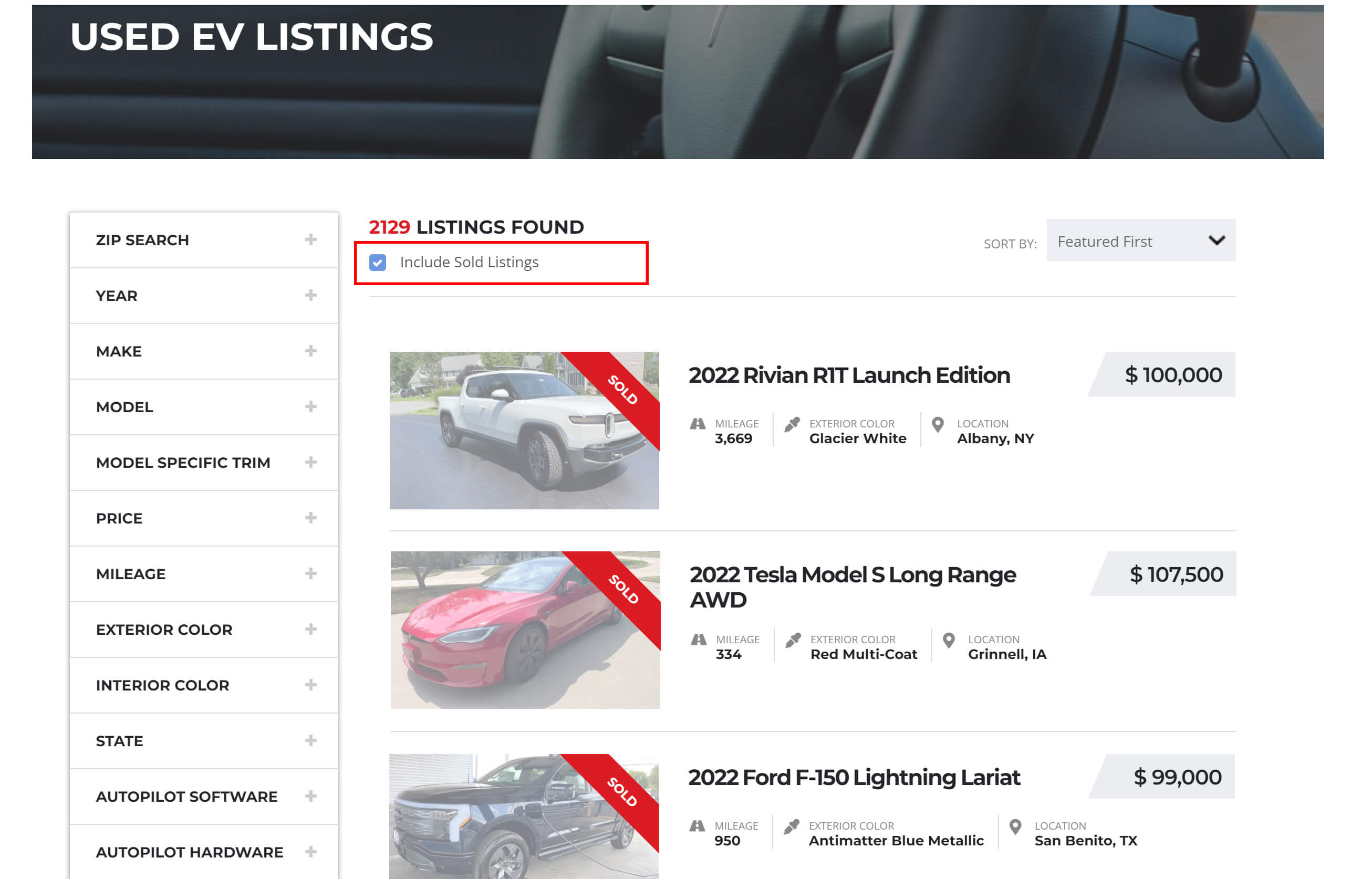
One thing to keep in mind: these are asking prices, not always final sale prices. Still, they can help you understand where similar vehicles have been listed and what buyers have been seeing in the market.
Other pricing sources can help too: current new vehicle inventory, manufacturer configurators, dealer listings, auction results, trade-in offers, private party marketplaces, and local availability. The more common the EV is, the more important it is to compare against what a buyer could get new today.
Other Limitations on EV Asking Prices
If you’re looking to flip a Tesla or EV, asking price is only one part of the equation. There are several other things to consider before assuming there is profit to be made.
Production Availability and EV Pricing
Production availability massively impacts what buyers are willing to pay.
If a buyer can order a new EV from the manufacturer and take delivery quickly, it is going to be difficult to convince that buyer to pay a premium for your nearly new one. If the new vehicle comes with full warranty, current software/hardware, direct manufacturer paperwork, and straightforward financing, your used EV needs a reason to compete.
This is especially true with Tesla. Tesla can change pricing, inventory discounts, financing offers, lease terms, software bundles, and delivery timelines quickly. A car that looked like a potential flip when you ordered it may not look that way by the time you take delivery.
This is important: if you are competing directly with a brand new Tesla or EV that can be delivered soon, you probably do not have much leverage to ask over MSRP.
The same logic applies to other EV brands. If the manufacturer is delivering quickly, dealer inventory is available, and shoppers have choices, the flipping market gets much harder.
Desired Model Configurations
Some EV configurations are more desirable than others, and this matters a lot when looking at EVs to resell.
For example, the Tesla Model X has historically been more desirable in six-seat and seven-seat configurations because many Model X buyers want the extra passenger capacity. A five-seat Model X can still be a great vehicle, but it may not attract the same buyer pool as a six-seat or seven-seat version.
Other examples are similar. Battery size, range, seating layout, towing equipment, wheel choice, paint color, interior color, performance trim, charging compatibility, title status, and service history can all change how easy an EV is to sell.
Also, a quick note on software: Full Self-Driving (Supervised) does not usually add anything close to its original retail cost on the used market. If you want to learn more about why this is the case, check out our post on what FSD is worth on a used Tesla.
Potential Dealer, Manufacturer, or Contract Restrictions
This is where people need to be very careful.
Some automakers, dealers, and purchase agreements have attempted to limit, discourage, or penalize immediate resale in certain situations. Sometimes this happens at the dealer level. Sometimes it appears in a manufacturer purchase agreement. Sometimes the language is tied to bad faith ordering, export, brokered purchases, or orders made with resale in mind.
Tesla’s current U.S. Motor Vehicle Order Agreement includes “No Resellers” language that allows Tesla to cancel an order before delivery if Tesla believes the order was made with a view toward resale or otherwise made in bad faith. Tesla’s agreement also says Tesla may keep certain fees in that situation, and it mentions third party facilitation/brokering and export-related concerns.
That does not mean every person who sells a Tesla after taking delivery is doing something wrong. People sell vehicles for legitimate reasons all the time. Life changes. Finances change. Family needs change. But it does mean you should read your actual agreement, understand the rules that apply to your transaction, and avoid doing anything that looks like an attempt to reserve, buy, broker, export, or transfer a vehicle in a way Tesla or another automaker does not allow.
We are not going to tell you how to work around Tesla’s rules, reservation rules, dealer restrictions, export restrictions, or title requirements. Follow the rules that apply to your deal.
Title, Loan, and Payment Risk
A lot of casual flipping math ignores title and payment risk.
If you finance the EV, your lender may hold the title or lien. If you sell too quickly, you may not even have the title paperwork finalized yet. If you sell across state lines, the buyer’s DMV may need documents your state has not issued yet. If the vehicle has a payoff, the buyer may not want to hand money directly to you without knowing the lien will be released. If the buyer pays with the wrong method, you could be exposed to fraud or reversal risk.
This is one reason we recommend using a service like KeySavvy for private party transactions where appropriate. KeySavvy can help with ownership/title verification, secure payment handling, lien payoff, temporary permits, and paperwork. That can be especially useful for out-of-state sales, financed vehicles, and higher dollar EVs.
Again, KeySavvy is not a workaround for ownership, title, reservation, tax, lender, DMV, or Tesla requirements. It is a transaction support tool, not a magic eraser.
Sales Tax and Profit Margins—Something Many Don’t Consider
OK—this is something that is really worth mentioning, and it is a point many people do not consider enough.
In many states, there is sales tax on EV purchases. That means when you buy an EV, you may pay a percentage of the purchase price to the state where the vehicle is registered. When someone buys it from you, that buyer may also owe sales tax in their state. The exact rules vary by state and transaction type, but the cost can be huge.
Let’s use Minnesota as a simple example, because that’s where Find My Electric is headquartered. If someone pays $100,000 for a vehicle and their applicable sales tax is 6.875%, that is $6,875 in tax before you even get into title, registration, insurance, financing, transport, listing, inspection, or income tax considerations.
That $6,875 can massively eat into the profit margin of a private party person looking to flip or resell an EV.
Dealers may be treated differently than private parties because licensed dealers generally hold vehicles for resale under different tax rules. Regular private party buyers usually do not have that same treatment.
There are also income tax considerations. If you sell an EV for more than your tax basis in the vehicle, you may have taxable income or other reporting issues. State rules may also matter.
And then there are EV-related tax credits and incentives. As of 2026, the federal new, previously owned, and commercial clean vehicle credits are not available for vehicles acquired after September 30, 2025. Older purchases, binding contracts, state incentives, local incentives, or special situations may have their own rules, so talk to a qualified tax professional before relying on any incentive in your math.
Our main point here is simple: sales tax, income tax, registration fees, title fees, loan payoff timing, insurance, shipping, inspection, and possible incentive issues can wipe out what looked like a profit on paper.
Stay compliant with all state and federal laws, and talk to an appropriate tax, legal, DMV, insurance, or financial professional when needed.
Can You Sell an EV Reservation Without Taking Delivery?
Ah, the age old question: “Can I sell my reservation or place in line for a profit without actually taking on the risk of buying the vehicle?”
We get this question sometimes, and there are a few things to consider:
- We do not allow sales of reservations on Find My Electric. Please do not try to sell a car you do not have yet, a reservation slot, an order, or access to an account. That is a big no.
- Tesla and other automakers generally do not support reservation flipping. Your actual order agreement, reservation agreement, or purchase documents control what you can and cannot do.
- Transferring an account to a stranger is a terrible idea. It can expose personal information, payment details, vehicle history, app access, and other sensitive information.
- Trying to sell around the rules can create serious problems. That can include cancellation, loss of fees, inability to complete delivery, title issues, tax problems, account problems, or future purchase restrictions.
We’re happy to help you sell a Tesla or EV once you actually own it, have taken delivery, and can legally sell it. But we are not here to help sell reservations, order slots, account access, or vehicles that are not in your possession and legally ready to be sold.
Can You Flip a Tesla or EV for Profit in 2026?
As noted above, sometimes, but it is much harder than it used to be.
The 2021-2022 EV flipping market was driven by a weird combination of low supply, high demand, rising new car prices, long delivery waits, generous incentives, and buyers who were willing to pay to skip the line.
The 2026 market is different. Tesla pricing can move quickly. More EVs are available. Many used EVs have depreciated. Federal clean vehicle credits ended for vehicles acquired after September 30, 2025. Buyers are more price sensitive. And the novelty premium has faded for many models.
That does not mean every quick resale loses money. But it does mean the math needs to be honest.
Before assuming you can flip a Tesla or EV for profit, look at:
- Your actual purchase price
- Sales tax and registration costs
- Title timing
- Loan payoff or lien release timing
- Insurance costs
- Transport costs
- Listing and transaction costs
- Current new vehicle inventory
- Current manufacturer pricing
- Used market asking prices
- Sold listing data
- Configuration desirability
- Warranty status
- Software status
- Title brand/history
- Any order agreement, dealer, lender, or automaker restrictions
- Tax consequences if you make a profit
That is a lot of friction for something that may or may not produce a real profit.
Where’s the Best Place to Sell a Tesla or EV?
You already know what we’re going to say here, right?
Find My Electric, of course! We’re the #1 used Tesla and EV marketplace on the web, and offer two ways to sell your Tesla or EV:
1) Create a Listing on Find My Electric!
We offer a Featured Listing for a one-time fee $49 which comes with all sorts of goodies, including a free Experian AutoCheck report. You also get access to our support team 7 days a week (even on weekends), and priority placement on the #1 used EV marketplace on the web!
We also offer a Free Listing option that’s totally free. It doesn’t come with the same bells and whistles, but it is truly free—and something else to consider. You can learn about our different listing options here.
2) Request an EV Cash Offer from our EV Dealer Network!
We created network of used EV dealers ready to make cash offers on Teslas and other EVs.
Some benefits of the Find My Electric EV Cash Offer include:
- Real potential offers from real EV dealers (not a random algorithm low-balling you)
- Our EV dealers understand what rare features like Unlimited Supercharging are worth
- All inspections are virtual—no need to drive your car to a random place before getting an offer
- Get potential multiple offers in single place
- EV dealers only—no random ICE/gas car dealers who don’t understand Teslas and EVs
- Convenient driveway pickup
- Zero cost or fees to you
And the best part is—you can choose one or both of the options above!
We’re also here to help, so if you have any questions, feel free to contact us at any time!