
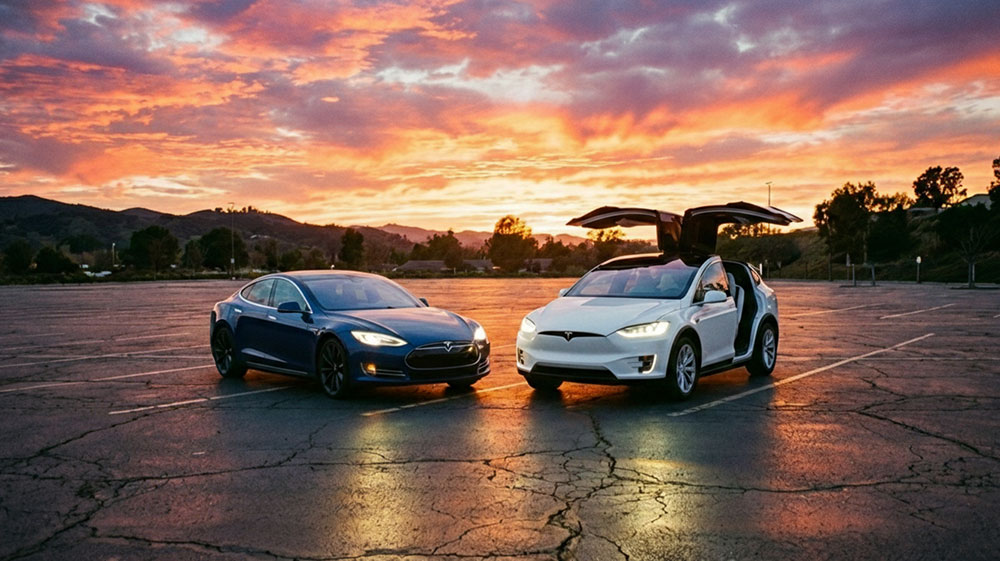
Tesla’s recent announcement that the Model S and Model X will be discontinued in mid-2026 immediately raised a familiar question among owners and buyers alike: does this mean these cars are about to become more valuable?
Any time a vehicle stops being produced, speculation follows. Some owners wonder if they should hold on longer. Some buyers wonder if this is the last chance to get in before prices rise. And others just want to know whether the used market is about to change in a meaningful way.
The short answer is that discontinuation alone doesn’t magically turn a modern car into a collectible or substantially raise the price. But the Model S and Model X aren’t normal cars—and history shows that certain market disruptions can move prices in ways people don’t expect.
Let’s break down what typically happens when vehicles are discontinued, why the Model S and X might be a special case, and what this could mean for buyers and sellers over the next few years.
One quick note before we continue: no one can predict used car values with certainty. Markets shift, policies change, and technology moves fast, so nothing in this post is a guarantee of future prices or outcomes. Use this as context, not instruction—do your own diligence, and make the decision that actually makes sense for you.
What Usually Happens When EVs Are Discontinued
Most discontinued EVs continue to depreciate much like they did before (and some even more so). Production ending doesn’t automatically create scarcity in a market where tens or hundreds of thousands of examples already exist.
That said, value trajectories can change when a few specific factors line up:
- New supply drops to zero
- Demand remains steady or increases
- There’s no clear replacement
- The vehicle retains real-world usability or novelty (such as Model S Plaid)
- The brand still commands attention
True appreciation—where prices consistently rise over time—is rare for modern vehicles. Much more common is value stabilization, where depreciation slows or flattens relative to similar alternatives.
That distinction matters. Slower depreciation doesn’t make headlines, but it absolutely matters to EV owners and buyers making real decisions.
Why the Model S and Model X Might Be Different
The Model S and Model X sit in a unique place in automotive and EV history.
They weren’t just early electric vehicles—they were the first EVs that genuinely replaced high-end gas cars without compromise.
Long range, serious performance (P85D, P100D, and eventually Plaid), real interior space, and access to a nationwide fast-charging network changed how people viewed electric cars entirely.
Even today, there isn’t a clean replacement for either model:
- The Model S still occupies a large, fast, long-range luxury sedan niche that Tesla no longer emphasizes.
- The Model X remains a uniquely spacious electric SUV with performance and utility that smaller crossovers don’t replicate.
Add in Tesla’s brand gravity and the fact that these models helped define the company itself, and you get something that behaves differently in the used market than a typical discontinued vehicle (despite the fact that these have been <5% of Tesla’s overall production for years now).
A Recent Real-World Example: Used Cybertruck Pricing
We’ve already seen how Tesla-related market disruptions can move used prices in unexpected ways—and quickly.
In mid-to-fall 2025 (prior to the expiration of the $7,500 federal EV tax credit), used Foundation Series Cybertrucks were regularly trading in the mid-$60,000 range.
At the time, eligible buyers could reap the benefit of the credit (at point-of-sale nonetheless) on the $79k non-Foundation AWD Cybertruck, driving the price to $72k and some change less Tesla fees and sales tax, keeping downward pressure on used pricing.
Then three things happened in short order:
- The $7,500 tax credit for that configuration disappeared in September 2025
- Tesla didn’t respond with a price cut
- Paid-in-full FSD was discontinued as a purchase option in February 2026
The result? Used Foundation Cybertrucks—already in circulation—suddenly looked far more attractive. Prices rebounded, with many examples now closer to $70,000 or higher depending on condition and spec.
This isn’t a guarantee that the same thing will happen with the Model S and X. But it’s a clear reminder that policy changes, pricing decisions, and product availability can shift used values fast, especially when demand doesn’t disappear.
What Past Tesla Discontinuations Suggest
Tesla has a long history of abrupt changes—trims disappearing, features being removed, entire configurations ending with little notice.
What the used market usually shows after these moments:
- A short-term spike in interest and search activity
- Temporary price firmness for clean, well-optioned examples
- Long-term divergence between average vehicles and standout ones for certain desirable trims or options (like “unicorn” AP2, FSD-capable Model S/X with Free Unlimited Supercharging tied to the vehicle)
In other words, not all Model S or X vehicles will behave the same way. Condition, mileage, spec, and production year sometimes matter more (not less) after discontinuation.
Which Model S & X Might Hold Value Better
While nothing is guaranteed, markets tend to reward certain characteristics consistently.
Stronger value retention candidates typically include:
- Lower-mileage vehicles
- Performance trims (people will still want a Plaid long after you can no longer buy one new from Tesla)
- Later production years with updated hardware
- Desirable interiors and exterior colors (Plaid sport buckets, Ultra Red, etc.)
- Clean history and documented maintenance
Weaker performers tend to be:
- High-mileage examples
- Early production years with outdated tech
- Heavily worn interiors or cosmetic issues
- Accident history or unclear ownership records
- Vanilla trims
Discontinuation sometimes amplifies these differences. Buyers might become more selective, not less.
Model S/X Potential Appreciation vs. Smart Expectations
It’s worth being clear: most modern cars do not meaningfully appreciate. Like, almost all of them don’t; that’s the way that cars work. That includes electric vehicles, no matter how important they are historically.
But appreciation isn’t the only outcome that matters.
For many owners, slower depreciation or temporary price stability is already a win. For buyers, knowing that a vehicle is unlikely to fall off a value cliff can make a purchase far more comfortable.
EV-specific factors still matter here:
- Battery health
- Software support
- Charging standards
- Ongoing service availability
- Rarer models (we’ll say it again: Plaid)
Markets change, technology moves fast, and personal timelines matter more than predictions. Anyone buying or selling should do their own diligence and make decisions based on their actual needs—not just forecasts.
What This Means If You’re Buying a Used Model S or X
As new Model S and X inventory eventually disappears in 2026, the used market becomes the only option. That might bring:
- More motivated sellers
- Wider price spreads between listings
- Buyers seeking quality examples of rarer trims (certain Plaids, “unicorn” S/X, 7 seater X, etc.)
For buyers, this makes comparison more important than ever. Asking prices may not always reflect real market value, especially during transitional periods.
EV-focused marketplace (like Find My Electric) become more useful here, because context matters. Comparing range, trims, years, mileage, and condition across similar vehicles leads to better decisions than browsing generic listings.
What This Means If You’re Selling a Model S or X in the Next Year or Two
For sellers, discontinuation creates optionality.
Some owners may want to test the market and wait for the right buyer. Others may prioritize speed, certainty, and simplicity—especially if they’re planning to move into a different EV.
There isn’t one “correct” approach. What matters is visibility into real demand.
That’s where platforms like Find My Electric come in. As an EV-only marketplace, we help Model S and X sellers gain potential exposure to buyers who actually understand these vehicles—not just people scrolling listings.
For those who don’t want to wait, we also offer cash offers from an EV-focused dealer network, allowing sellers to have another potential option aside from selling privately.
Why Find My Electric Becomes More Important After Discontinuation
When a vehicle can no longer be purchased new, the used market becomes the market.
Generic car platforms tend to lump EVs together without nuance. EV-specific marketplaces surface better comparisons, cleaner pricing signals, and potentially more qualified buyers.
As the Model S and X transition from current production vehicles to legacy models, that focus matters more—both for buyers and sellers.
Final Take: Will Tesla Model S/X Values Jump After Being Discontinued?
A dramatic, sustained price jump is unlikely for most Model S and X vehicles. But that was never the most realistic outcome.
What is realistic is stronger-than-expected value retention for clean, well-optioned examples—especially if demand stays healthy and no true replacements emerge.
For owners, the opportunity is timing and flexibility. For buyers, it’s access to two of the most important EVs ever built—vehicles that soon won’t be available new from Tesla at all.
If you own a Model S or Model X and are thinking about selling, you can list your EV for sale on Find My Electric to potentially reach EV-focused buyers, or request a cash offer from our EV Dealer Network (or both).
If you’re on the buying side, browse our current used Model S and Model X listings today!