
Saving your hard-earned cash and reducing commuting emissions may hit the top of your list of reasons for considering a used electric car, but which used EVs can actually handle your daily commute?
We’ve assembled a refreshed list of the best used electric cars for commuting in 2026, with picks for different budgets, drive lengths, charging setups, and comfort needs.
Quick note: Used EV prices, range, battery health, warranty coverage, software features, recalls, and charging access can vary a lot by year, trim, mileage, title history, location, and how the vehicle was used. Always check the specific car’s history, battery condition, warranty status, recall status, charging equipment, and actual listing details before buying.
But before we get there, let’s take a trip through some EV commuting needs:
Essential Features for Electric Commuter Cars
To figure out how to prioritize used EV features for your commute, you’ll need to ask yourself a few questions:
How far do I drive during my daily commute?
Your daily commute may be as short as ten minutes or last over an hour, and the distance will heavily influence how much range you’ll need in a commuter electric car.
A commute of about 40 miles per day is easily covered by the average range in newer used EVs. However, the stated range on an electric vehicle isn’t the whole story of how well it can handle your daily route. Weather, speed, tire pressure, elevation, battery age, charging habits, and cabin heat can all change the real number.
If your commute is very short and you won’t be driving more than around 150 miles per week, you can get away with a smaller battery pack, which typically translates to a cheaper EV. For a commute of 40 miles or less, an EV with roughly 100-150 miles of usable range may be plenty, especially if you can charge at home or work.
For commuting over 40 miles per day, a vehicle with average to above average range is usually the better fit. For longer commutes, we’d look for a used EV with 200-300+ miles of rated range, or at least enough real world range to cover your commute with a comfortable buffer.
Will I be charging my EV at home, work, a charging station, or a combination of these?
If you can charge at home or at work, you can easily replace the range of a short commute during the day or overnight. A regular 120-volt Level 1 outlet can work for shorter commutes, though it adds range slowly. A 240-volt Level 2 setup is much more convenient if you drive a lot.
A longer commute may require Level 2 charging at home, a reliable workplace charger, or a used EV with enough battery to avoid charging every single day. You might also use DC fast charging, but relying on public fast charging as your only regular charging source can become expensive, inconvenient, and harder on the battery over time.
A word for those who will not be able to charge their EV at home because of apartment living, street parking, or inconvenient parking: a larger battery pack that covers most of your weekly commute is usually better than a smaller battery pack that only covers a day or two. If you can get away with charging once a week instead of hunting for a charger every other day, your commuter EV will feel a lot easier to live with.
Is Connectivity, Infotainment, or Driver Assistance Software an Essential Part of My Commute?
If you use your daily drive to catch up on the latest news, listen to podcasts, make calls, or chill out with your favorite playlist, check each used EV prospect for its infotainment setup, Bluetooth behavior, Apple CarPlay, Android Auto, navigation, and cellular connectivity.
Tesla handles media integrations in house, and Premium Connectivity is a separate subscription unless the vehicle has lifetime Premium Connectivity or an active trial. Many other EV manufacturers rely more heavily on Apple CarPlay or Android Auto.
What about driver assistance software in a used EV? If you do a lot of highway driving, adaptive cruise control, lane keeping, or Tesla Autopilot can help lower driving fatigue. Just make sure you understand what the car actually has. On a Tesla, Autopilot, Enhanced Autopilot, and Full Self-Driving (Supervised) are not the same thing, and used listings are not always accurate.
Does the Used EV I’m Considering Have a Good Safety Rating?
While most modern vehicles have a high degree of safety, there are some that are a cut above the rest. Research each used EV option through the National Highway Traffic Safety Administration (NHTSA) and Insurance Institute for Highway Safety (IIHS) websites to make sure your prospective year, make, and model tested well.
Tip: if part of your commute involves taking a car seat in and out of the car, be sure to check out the IIHS ease of use rating for each used EV’s LATCH system. Range is great, but wrestling a car seat into a bad second row every morning gets old fast.
Will This EV Be a Comfortable Long Term Commuter?
While we know that comfort definitely isn’t at the bottom of most commuters’ lists, it may not be your first thought when you are looking at an EV. Range, battery size, cost, and tech tend to overshadow a lot of other features when we discuss electric cars.
However, comfort should be ranked close to budget on your list. You and this EV commuter car will likely be spending lots of quality time together.
The more range you need, the more comfortable your ride should be. The best electric car for a long distance commute should offer some combination of supportive seats, decent cabin noise control, heated seats, a heated steering wheel, good climate controls, enough storage, and driver assistance features that actually make your drive less tiring.
With these questions in mind, let’s talk through our refreshed picks for used EV commuters:
Best Overall Used EV Commuter Car: Tesla Model 3
Used Price: $16,000-$38,000+
Range: roughly 220-358 miles, depending on year, trim, wheel package, and battery condition
Strengths: long range options, strong charging network access, high safety scores, strong tech, good efficiency, many examples under $30k
Weaknesses: no Apple CarPlay or Android Auto, some road noise at highway speeds, used listings can overstate FSD or Autopilot status
Recommended for: most commutes, longer highway commutes, cold climates, drivers who want strong charging access and Tesla software
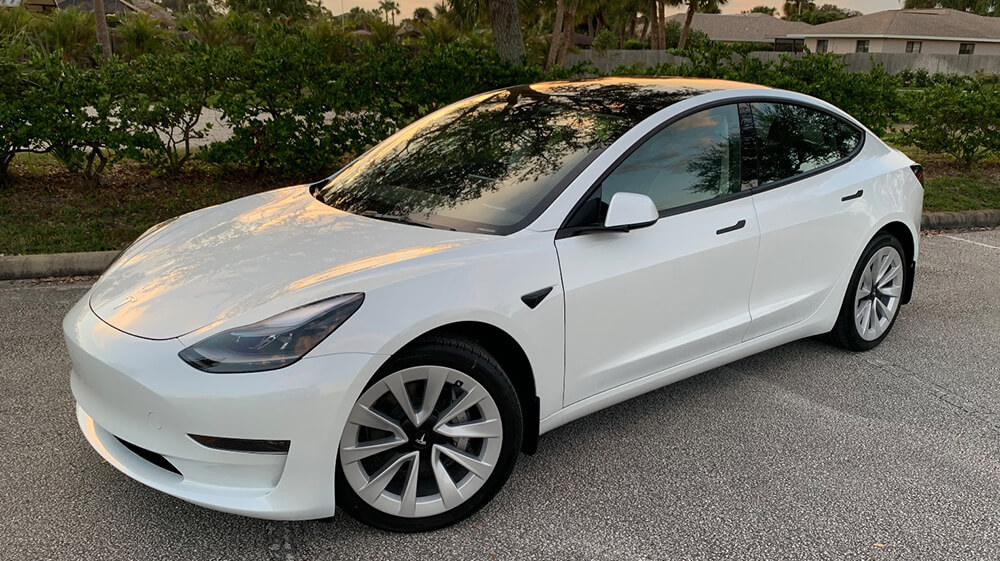
The Model 3 still checks the most boxes for a used EV commuter. It has enough range to handle weekly charging for short commutes, enough efficiency for longer drives, and access to Tesla’s charging ecosystem. It also has one of the largest used EV markets, which means you can shop by year, trim, mileage, battery warranty, Autopilot hardware, color, wheels, and price instead of taking whatever happens to be available.
For the best used Model 3 commuter value, 2018-2021 examples are still the sweet spot for many buyers. Standard Range Plus cars can be very affordable, while Long Range cars give you more breathing room for highway driving, winter range loss, and less frequent charging.
For the best use of the Model 3’s tech options, check the car’s actual Autopilot hardware and software status. Earlier Model 3s may have Hardware 2.5 unless they received an upgrade. Full Self-Driving is now called Full Self-Driving (Supervised), and a used Tesla may have paid-in-full FSD, a subscription, a trial, Enhanced Autopilot, basic Autopilot, or none of the above. Don’t rely only on a seller’s wording; check the vehicle’s software screen and documentation.
Safety ratings and reviews from both the Insurance Institute for Highway Safety (IIHS) and the National Highway Traffic Safety Administration (NHTSA) have been strong for the Model 3.
For cold climate use, Teslas and other EVs will lose some range because of heating, battery temperature, tires, and road conditions. However, you can tell a Model 3 to precondition before you drive by using the Tesla app to set the cabin temperature or run defrost before you leave.
One downside we still see with the Model 3 is that road noise at highway speeds can be noticeable, especially on older cars and larger wheel packages. The noise level usually isn’t a dealbreaker, but if you spend two hours a day on the highway and take a lot of calls, it is worth test driving at real commute speeds.
Best Used Electric Crossover Commuter: Tesla Model Y
Used Price: $24,000-$45,000+
Range: roughly 244-330 miles, depending on year, trim, wheel package, and battery condition
Strengths: practical cargo space, good range, Tesla charging access, hatchback layout, available third row on some models, many 2020-2021 examples now near or under $30k
Weaknesses: more expensive than many smaller commuter EVs, larger wheels can hurt ride comfort and range, optional third row is tight, no Apple CarPlay or Android Auto
Recommended for: commuters who want Model 3 efficiency and tech with more cargo room, family use, pets, kids, road trips, and weekend errands
The Model Y has become one of the easiest used EVs to recommend for people who want one car to handle commuting, errands, kids, dogs, luggage, road trips, and normal life. It is not as sleek as the Model 3 and it usually costs more, but the added space makes it easier to live with.
Early Model Y prices have also come down enough that this crossover now belongs in the used commuter conversation. Some 2020 and 2021 Model Y Long Range examples can be found around the same price as a newer used Model 3, especially with higher mileage or less desirable configurations.
For commuting, the Model Y’s biggest advantage is flexibility. You get a higher seating position, a large hatch area, a roomy second row, and strong charging access. For buyers who can only own one car, that can matter more than squeezing out the lowest possible purchase price.
The main thing to watch is condition. Early Model Y builds can vary, and larger wheel packages can make the ride firmer and replacement tires more expensive. Check the tires, suspension noises, alignment, glass, interior wear, title history, warranty status, and software status before buying.
Most Comfortable Used EV for Long Commutes: Tesla Model S
Used Price: $14,000-$80,000+
Range: roughly 150-405 miles, depending on year, trim, battery pack, wheel package, and battery condition
Strengths: long range options, comfortable cabin, strong highway manners, large hatchback cargo area, premium audio on many trims, fast charging, Tesla tech
Weaknesses: older examples may have no basic warranty or battery warranty remaining, repair costs can be higher, air suspension and door handles deserve extra attention, Model S production ended in 2026
Recommended for: long commutes, business travel, storage space needs, highway comfort, buyers who want a larger premium EV without buying new
The Tesla Model S provides range, style, driver assistance software, fast charging, and a much larger cabin than the Model 3. For a long commute, the Model S still makes a lot of sense if you want a quieter, roomier, more comfortable Tesla and you are willing to take on the upkeep risk of an older premium vehicle.
While a newer Model S remains a higher budget option, older Model S years can now be found well under $30k. That can make the Model S look like a steal, but be realistic: a $20k Model S is still a premium EV with premium repair exposure. Air suspension, door handles, infotainment hardware, battery health, drive units, tires, and service history all matter.
Many of the oldest Model S examples have smaller battery packs, higher mileage, more degradation, and no remaining basic warranty coverage. Some older cars may still have interesting features like Free Unlimited Supercharging, lifetime Premium Connectivity, or legacy Autopilot/FSD equipment, but those features need to be verified carefully because transfer rules and account status can be complicated.
It is also worth noting that Model S is now a legacy Tesla from a production standpoint. Tesla ended Model S and Model X production in 2026, which makes the used Model S market more important for buyers who still want Tesla’s large sedan.
A used 2019-2021 Model S Long Range, Long Range Plus, or refreshed Model S can be a strong long commute option if the budget allows. For strict budget shoppers, older 2014-2017 cars can work, but they deserve a more careful inspection than a used Model 3.
Best Budget Electric Commuter: Nissan LEAF
Used Price: $5,000-$25,000+
Range: roughly 84-226 miles for older used LEAF models, depending on year, battery size, trim, and battery health
Strengths: low purchase price, simple controls, reliable commuter reputation, easy to drive, widely available, Apple CarPlay and Android Auto on many newer examples
Weaknesses: CHAdeMO fast charging on older models, slower fast charging, passive battery thermal management on 2011-2025 LEAF models, not ideal for frequent long distance driving
Recommended for: short commutes, home charging, workplace charging, budget buyers, second car duty, simple around town driving
While you can get a lot of mileage out of an old Nissan LEAF, we’d focus most used shoppers on the 2018-2025 generation unless the budget is extremely tight. The 40 kWh LEAF works well as a short commute car, while the LEAF Plus gives you more usable range with a larger pack.
The LEAF’s main commuter strength is price. A used LEAF can be one of the cheapest ways to get into an EV, especially if you can charge at home and your commute is predictable. It is not the best road trip EV, but it can be excellent for daily driving, school runs, errands, and local commuting.
The biggest thing to understand is the battery and charging setup. Older LEAF models use CHAdeMO for DC fast charging, and CHAdeMO stations are becoming less common as CCS and NACS dominate more of the public charging market. The 2011-2025 LEAF also does not have the same kind of active liquid battery cooling found in many newer EVs, so repeated fast charging and extreme heat can matter more.
That does not mean the LEAF should be ignored. It just means you should buy it for the right job. If you can charge at home or work and your commute is less than 40 miles a day, a used LEAF can be one of the most financially sensible EV commuters around.
One note for 2026: the redesigned Nissan LEAF is a very different vehicle, with a larger 75 kWh liquid cooled battery and much more range. That does not change the value case for older used LEAF models, but it does mean future used LEAF shopping will eventually include two very different generations.
Which Used EV Commuter Should You Choose?
The best used electric commuter car depends less on the badge and more on your routine.
If you want the best all around used EV commuter, start with the Tesla Model 3. It has range, charging access, efficiency, software, safety, and enough used inventory to shop intelligently.
If you want more space and still want Tesla software and charging access, look at the Tesla Model Y. It is especially compelling now that early used Model Y prices have softened.
If you want a more comfortable long distance commuter and you are comfortable with older luxury EV upkeep, the Tesla Model S still deserves a look.
If your commute is short, your budget matters most, and you can charge at home or work, the Nissan LEAF can be a very practical choice.
Ready to Start Searching for a Used Commuter EV?
Now that you’ve got a good idea of what features you need in a used electric commuter car, it’s time to check searching for it off your to-do list.
We’ve made it easy for you. With Find My Electric’s filtering system, you can select and sort through thousands of used EVs by battery size, price range, Autopilot software and hardware, location, and more. Narrowing down your options has never been simpler, and there are no distracting gas car listings to confuse your efforts.
Looking for a used Model 3 commuter with good range and the right Autopilot hardware? Want a used Model Y with more cargo space? Trying to compare a used Model S against a lower priced used Nissan LEAF? You can filter for what actually matters.
Get on the road faster without sacrificing your budget. Check out Find My Electric’s used EV listings to find your next electric commuter car today!